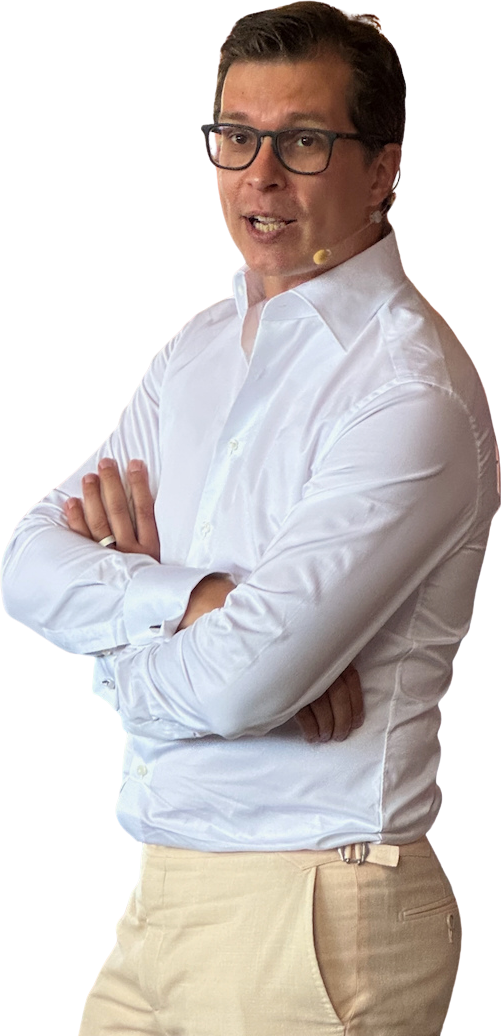
 Polle de Maagt
  Polle de Maagt
Story.
The first time I saw someone use this structure was in a huge auditorium in Hasselt, filled with 1,500 students. I had ended up on stage to help check whether the speaker’s laptop was connected properly. The speaker was Bert Dries, better known as Musketon. It gave the venue a concert-like vibe. I loved it.
Later, when Ella was small, I showed her a wave. She told me she wanted me to do one every time I gave a presentation abroad. So, for years, that is exactly what I did.
What looks like a spontaneous audience trick is actually carefully designed: the invitation makes it relevant, the room makes it possible and the dry run makes the final wave work.
How to run it.


Invitation.
Make the wave a logical part of your talk, not a random gimmick. Show your skin in the game. Tell a short personal story and ask the audience to do it for someone you care about (a true story obviously, not a fake one; a wave is difficult to orchestrate without a clear purpose and invitation).
How space is arranged and materials needed.
Use a theatre or conference-room layout. Show a short example so people immediately understand the movement. If you are recording, have your phone unlocked and ready. Watch for projector light flaring into the camera.
How participation is distributed.
Everyone contributes. The effect only works when the room acts together.
How groups are configured.
Keep the audience as one group. Start at the front and let the wave travel through the room. In a wide room, let it move from left to right instead.
Sequence of steps and time allocation.
- Set it up. Explain why the wave belongs in this moment.
- Show it. Invite everyone to participate and show an example.
- Practise. Run one practice wave. Ask for more energy if needed.
- Go. Run and record the final wave.
- Thank. Thank the audience.
Variations.
- Let the wave travel front to back in a deep room.
- Let it travel left to right in a wide room.
- Skip it when the room is too small: without enough people, it loses its effect.
Before your next talk, write one sentence that makes collective participation a logical part of your story. If you cannot write that sentence, do not add the wave.
Origin: Bert Dries, shared here with his permission.