 Polle de Maagt
 Polle de Maagt
What is the problem?
I see it everywhere. Some presentations are all head: they try to overpower the room with arguments and numbers until the point is made. Others are all heart: they run on belief, on how things should be. Those get dismissed as too emotional, too spiritual or too dogmatic.
What I miss most is the hands. What has to happen now? What can people actually do? How can they join? What is the next action? Without that, you have shared information or presented a PowerPoint, and nothing has changed. It keeps coming back.
How does the model work?
- Head: does it add up? The logic, the numbers, the proof. If the reasoning does not hold, the rest does not matter.
- Heart: does it feel right? Why it matters, who it is about, what is at stake. It has to feel right, not only add up.
- Hands: can people do it? The next step, who does what, by when, how people can join. If nobody can act on it, it was an ad, not an act.
Use it twice.
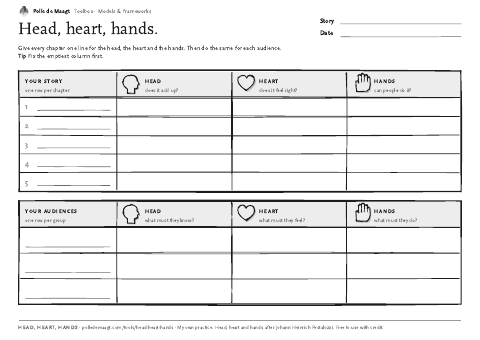
For yourself, in the story. Before you build slides, write next to each chapter what it gives the head, the heart and the hands. One line each.
- Head: which facts and which logic carry this chapter?
- Heart: which person, image or tension makes people care?
- Hands: what can someone do after this chapter that they could not do before?
A chapter with three filled lines works. A chapter with one is a slide you can probably cut, or a chapter that needs more work.
For each audience. The same story needs a different mix for every group in the room. Put your audiences in rows and head, heart and hands in columns: the story-audience matrix with three fixed columns. One sentence per cell: what does this group need to know, feel and do?
What does it look like?
One story, three audiences.
- Board. Head: the business case and the cost of doing nothing. Heart: confident it is the right bet. Hands: decide today.
- Managers. Head: what changes for their team, and when. Heart: involved, not just informed. Hands: tell it to their team this week, in their own words.
- Team. Head: why this, why now, and does it match the reality of their work. Heart: seen, and safe enough to try. Hands: one first step on Monday.
The empty cell is where the work is. Often it is the hands for the board. The team needs less head than the board, but it still has to add up and match their reality.
Why does it matter now?
AI makes the head cheap. A tool writes a correct, well-argued deck in seconds. What it cannot do is decide what this room needs to feel, or what this team can actually do on Monday. That is where the work moves: to the heart and the hands.
Take the story you are working on. Draw three columns: head, heart, hands. Give each chapter one line per column. Then do it again for your most important audience. Fix the emptiest column first.
Origin: head, heart and hands goes back to the Swiss educator Johann Heinrich Pestalozzi (1746 to 1827), who wanted learning to engage the intellect, the emotions and practical skill together. In communication it lives on as know, feel, do. Head and heart is a pair you hear a lot; adding the hands is what keeps helping, so I use it for every presentation I make. Related: the story-audience matrix, story chapters and the empathy map.