 Polle de Maagt
  Polle de Maagt
Story.
Sometimes you have too much in your head. There are several things going on, and you want to get a clear view of them.
The exercise I learned was simple. A three-by-three grid. Nine boxes. Write down what is on your mind, with a maximum of nine things.
Get it out of your head and onto the page. Often, that overview already helps.
I once did it with my daughter, when her head was too full. Nine boxes helped us get sharp on what really mattered right then.
I also use it with managers starting in a new role. A quick grid gives them focus, an overview and some insight before the next meeting fills their head again.
The question is not “What are my nine priorities?” but “What has my attention right now?” Capture first. You do not have to organise, judge or solve what you write down.
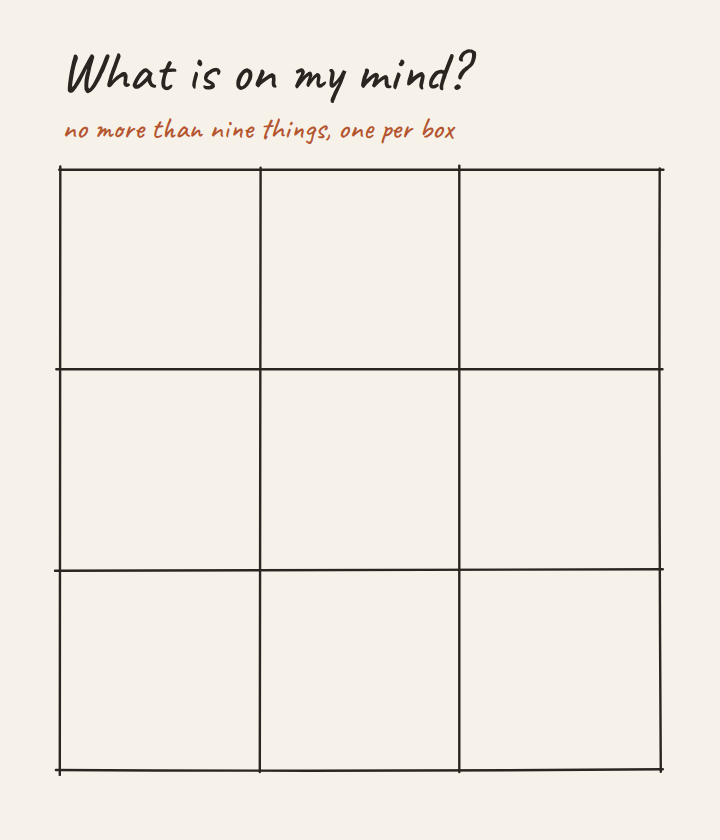
How to run it.


Invitation.
“What is on your mind right now? Write down no more than nine things. One thing per box. You do not have to solve them, rank them or share them.”
A thing can be a question, a worry, an unfinished conversation, an idea, something you are looking forward to or a practical task. Work and life can sit on the same page.
How space is arranged and materials needed.
One page. Draw three rows and three columns, making nine boxes. Something to write with.
How participation is distributed.
Start with your own thoughts. Use a few words you will recognise later. There is no prescribed order: the centre box is not more important than the corners. Empty boxes are allowed; nine is a maximum, not a target. If you are facilitating, leave space for silence and do not turn every box into advice.
How groups are configured.
Alone, or with a team such as a management team. Everyone fills their own grid first. Then compare: what shows up for several people, and what only for one? Sharing is optional, and do not collect or photograph the pages without permission.
Sequence of steps and time allocation.
- Make the page. Draw three rows and three columns.
- Ask the question. “What is on my mind right now?” Start with what comes up, not with what you think ought to matter.
- Write. One thing in each box, in any order. Stop at nine. Do not rank or solve while writing.
- Look. Take a quiet moment to see the page as a whole.
- Notice. What do you see now that was harder to see when it was only in your head? A connection, a surprise, a recurring concern, or simply what is there.
- Stop, unless you need more. An overview is a valid result. There does not have to be an action at the end.
10 to 15 minutes in total. It is a quick dump, not a long reflection.
If you want a next step.
Getting an overview and making a choice are different tasks. Only take a next step if you need one.
- More understanding: choose one box and write what is actually occupying you about it.
- A conversation: decide whom you want to talk to and what you want them to understand.
- An action: choose one concrete next step, rather than creating nine new obligations.
- Nothing yet: keep the page, put it away or discard it.
Something can take up a lot of attention without being your highest priority. Do not confuse how present a concern feels with how important it is to act on.
For a team whose normal prioritisation process is not producing clear choices, must-win battles is another option.
Variations.
- A conversation starter: fill the page before a coaching or one-to-one conversation and choose what, if anything, to discuss.
- A second snapshot: repeat the exercise later on a new page and notice what has changed. This need not become a progress score.
Draw nine boxes. Put the things occupying your head into them, one per box. Stop at nine and look at the whole page before adding another task.
A 3×3 exercise I learned from a manager I am friends with. Original creator unknown. Closest in spirit to the Mind Sweep in David Allen’s Getting Things Done, but not derived from it.