 Polle de Maagt
  Polle de Maagt
I talked about gradual engagement before, and especially how Facebook forces gradual engagement. Where on Facebook engagement is needed to stay in the user’s news feed, Twitter has a similar, but different, problem.
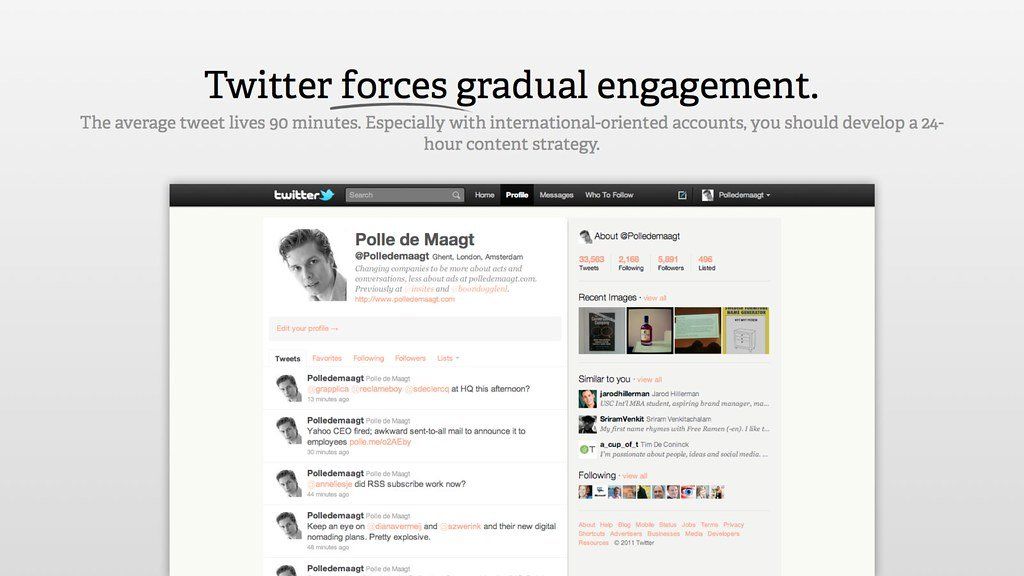
Tweets (even more than Facebook status updates) have an extremely short life.
They quickly drown in the sheer amount of tweets people produce. Most tweets only live for an hour. An analysis by Sysomos of 1.2 billion tweets in 2010 showed that 29% of tweets get a reaction (which is similar to our own InSites Consulting research that showed that 75% of social media messages go unanswered). A stunning 92.4% of all retweets happen within the first hour of the original tweet being published, while an additional 1.63% of retweets happen in the second hour, and 0.94% take place in the third hour.
That’s a serious attention challenge. To counter this content decay, there are different approaches:
- Timing. Understanding when our community is listening or watching. If we understand when our community is engaged, it becomes easier for us to engage meaningfully.
- Frequency. The more we repeat the conversation, the better our chances are of the community seeing that content.
- Relevancy. Understanding what our community actually wants to read, share and talk about, instead of pushing a campaign message, is soooo much more effective.
- A story worth sharing. Building a story that goes beyond single campaign tweets increases the chance that the community picks up at least parts of the story.
- Relationship. Building a long-term relationship around an ongoing conversation makes sure tweets go unnoticed less often.
That, again, shows that campaigns alone (short, intensive brand efforts to have high impact and reach) won’t do, and that brands need to move towards a more gradual approach and engage consumers throughout the year. That brands have to adopt a conversation management approach that is both reactive and proactive, and both service-driven and marketing-driven.
As much as Facebook does, Twitter forces gradual engagement.
Interested in more about content decay and attentionomics? Check Steve Rubel’s talk at this year’s The Next Web in Amsterdam (as captured by @wilg).
Written in 2011, left as it was. Where I took it later: How Facebook forces gradual engagement.
Original: How Twitter forces gradual engagement, 20 July 2011. Historical links may no longer work.