
So, what will social media do for my sales?
Some hardcore sales people will approach social media merely as a 2.0 version of their mailing lists: let’s build a huge database of Facebook likes and/or Twitter followers and spam them with discounts. Some social media idealists and evangelists approach social media sales or ROI as a forbidden word/discussion. In their opinion, relations and conversations eventually lead to better contact and better sales.
I tend to agree with both. And even with some others.
Some approaches to social sales are more tangible and direct than others. It is easy to measure what clickthroughs bring in terms of sales. It is more difficult to measure what volume and sentiment of conversations bring. Even measuring Net Promoter Score isn’t so obvious (and requires a special action of the consumer to rate the brand). That is why we mapped social sales on two axes: Direct versus indirect and brand initiated versus consumer initiated.
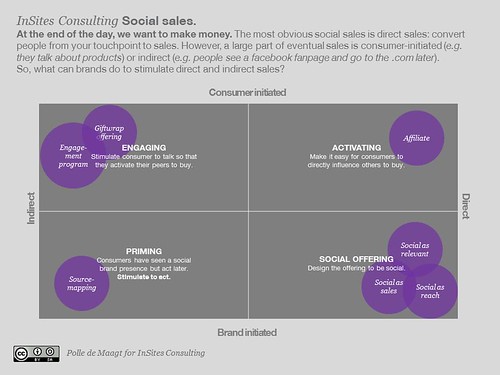
That gives us four quadrants:
- Social offering (brand initiated and direct) Most directly linked to sales and easiest to measure direct impact. Direct clickthroughs from social media efforts: clicks from Facebook or twitter, orders from a mobile app, etc. Design your sales offering to use the social infrastructure:
- Approaching social media as a reach instrument E.g. collecting as many Facebook or Twitter fans and approach it as a mailing list 2.0, like the Dell Outlet twitter account.
- Using social media for ‘social as sales’, only selling when consumers buy together. E.g. daily deal sites like Groupon or a offering like ‘buy 2 together with a friend, get 1 for free’.
- Using available social media data to offer relevance E.g. targetted advertising within Facebook, re-messaging or retargetting campaigns.
- Priming (brand initiated and indirect) People who engage with a brand on, for example, a Facebook fan page and don’t click directly, but return later. A lot of consumers will browse sites, facebook, twitter and other platforms to finally make the sale via direct traffic to the site (typing philips.com) or Google. That would normally mean that Google and direct traffic would be valued ‘too high’ while Facebook and other social platforms would be valued ‘too low’. Conversion attribution would solve this problem for the largest part and will help to give a more ‘honest’ representation of how social and conversations help to generate sales. For more, read my article on conversion attribution and social sales.
- Activating (consumer initiated and direct) Easy to measure, but initiated by consumers. A consumer talks about the brand and activate others directly to buy a product E.g. an affiliate link, a link to a specific discount or shares the product he/she just ordered.
- Engaging(consumer initiated and indirect) This is the most vague and idealistic one. There is much indirect proof that positive word of mouth leads to sales. However, it is really hard to prove exactly what that effect is. A consumer talks about a brand, shares content but doesn’t add a direct call to action. Just ‘normal’ chatter that influences peers, but hasn’t a direct link to sales.
- Engagement program Have a clear program to fuel conversations and make consumers more and more engaged. Have a look at our conversations / engagement funnel.
- Gift-wrap your sales offering Don’t use sales promotion as mere sales promotion. Use your sales promotion to drive brand and conversations. Construct your sales promotions in a smart and converting way. More background and examples in this post.